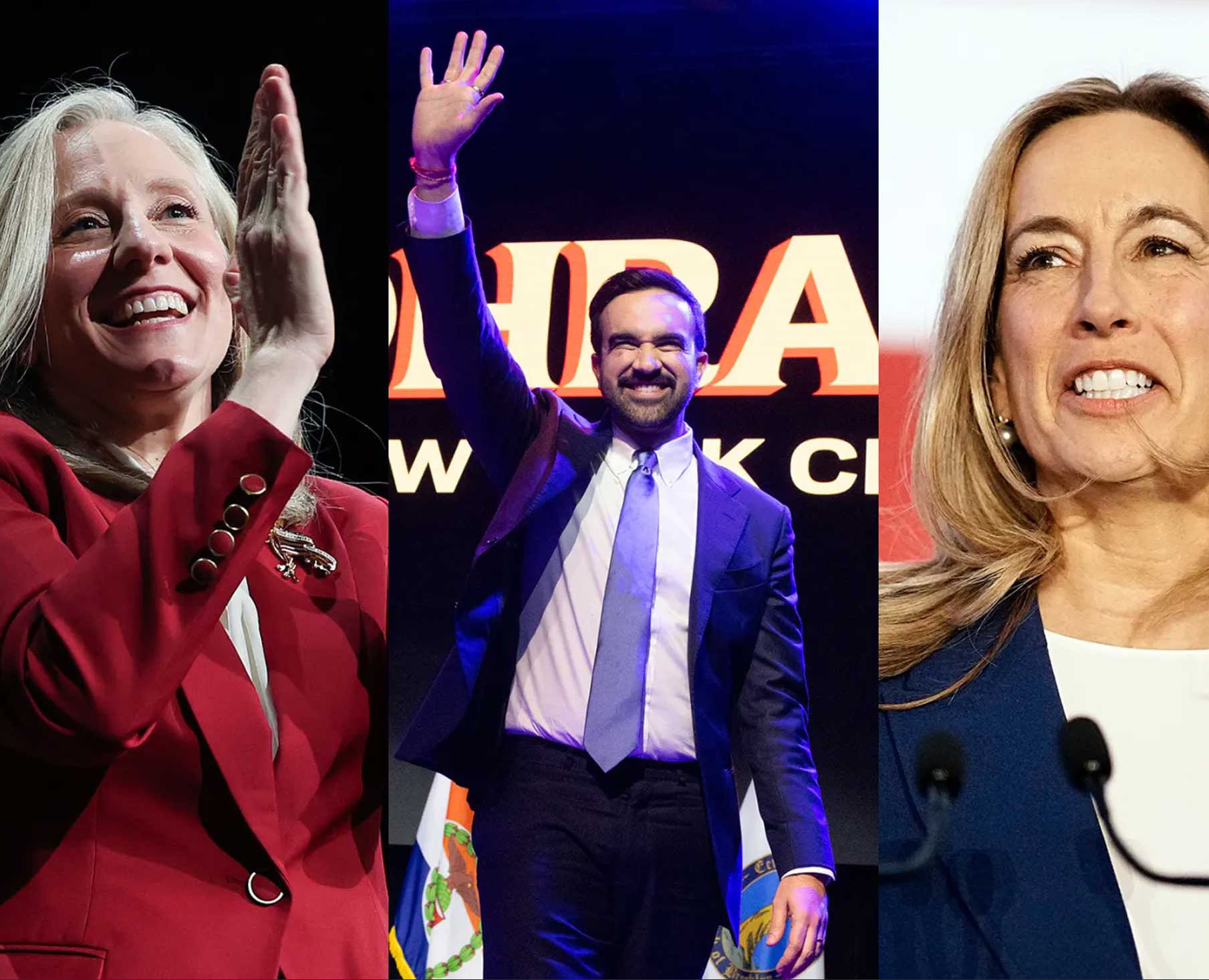
Democrats romped in the off-year elections earlier this month. They can’t squander the moment with the midterms looming
The technical term is an ass-kicking.
Democrats came roaring back in the 2025 off-year elections, flipping seats from governor to positions in state and county legislatures, with the GOP failing to win any real pick-ups under the weight of Donald Trump’s plummeting popularity.
Gone is the talk of Trump’s single-handed domination of our politics and the futility of resistance. American elections are functioning and Trump’s second honeymoon is over, as prices continue to rise and the ghost of Jeffrey Epstein haunts the president and his allies.
But Democrats need to learn the lessons from their big November night. Because whatever sugar high they may be feeling will soon collide with the fact that their party’s approval rating is still stubbornly lower than Trump’s, according to multiple polls compiled by CNN.
Much of the media focus is on the extraordinary elevation of the 34-year old Democratic Socialist Assemblyman Zorhan Mamdani to the New York mayoralty after polling at one percent a year ago. But if you dig into the data you’ll see that over indexing his win risks the danger of misreading the mandate. That reality check should temper any temptation among Democrats to lurch to the far left.
Over in New Jersey and Virginia, Governors-elect Mikie Sherril and Abigail Spanberger won victories, both with 57 percent of the vote, in states that often elect Republican governors. Democrats made gains in gains in virtually every county compared with last year’s presidential election. Yes, they benefited from backlash against Trump, but crucially they made gains among middle-class moderates in the suburbs, and even improved margins in rural areas. That’s a formula that can propel Democrats to victory in the midterms and beyond.
Here’s the key stat to keep in mind: Mamdani won barely 50 percent of the vote in a city that’s six to one Democrat. When all the votes are counted, he could well dip below majority support – which is academic to the extent that his opposition was split between red beret Republican Curtis Sliwa and former Governor Andrew Cuomo, running half-heartedly as an independent. But for the Democratic nominee to barely break 50 percent in NYC is not a massive mandate.
Yes, Mandami succeeded in inspiring a young liberal base. Yes, he ran a brilliant and simple campaign. More than a million people turned out to support him. His campaign message was relentlessly focused on affordability and personal authenticity expressed through compelling short form digital videos on social media.
Those are clear lessons that Democrats across the spectrum can learn from. In fact, Governors-elect Sherril and Spanberger also focused their messages almost exclusively on affordability and the economy. They refused to get drawn into divisive culture war debates.
They also share a broad political profile which can help Democrats expand their appeal nationally. Both women were decidedly centrist members of Congress with national security street cred: Sherril was a former Navy helicopter pilot and Spanberger was a former CIA analyst.
In contrast, Mamdani’s profile is less likely to help win swing districts and swing states. He has never worked in the private sector and has no record of military service or executive experience – which is a practical challenge for managing a $117 billion budget.
While he is now a national hero to the Bernie Bros, Mamdani is already a punching bag for national Republicans. As my friend, New York 1 anchor Errol Louis has joked: Mamdani is everything the Tea Party accused Barack Obama of being: born in Africa; a Muslim and a socialist. None of that, of course, excuses race-baiting or fear-mongering from Republicans.
Part of the genius of Mamdani’s campaign is that he may have been an avatar for identity politics, but he never played that card hard. While he resisted criticizing policies or people to his left (only half-heartedly distancing himself from calls to “globalize the intifada” and his own past tweets calling to defund the police), Mamdani offered a relentlessly upbeat demeanor and famously smiling face that inspired hope in many at a time when that is in short supply. His success was a prime example of Maya Angelou’s admonition that people might not remember what you said but they remember how you made them feel.
That’s exactly why the contrast with his victory night speech and those offered up by Spanberger and Sherill was so stark.
Spanberger called for “pragmatism over partisanship” in a state that has suffered under Trumpism’s right-wing policies. But Mamdani met his triumphant moment not with a call to unity in a divided city but something close to a socialist manifesto, name checking Eugene Debs in the opening paragraphs, slamming Trump and Cuomo, and generally promising a new ideological order
That’s clearly what he believes his mandate to be. But the job of mayor is effective management – it is essentially a non-ideological problem-solving position. As his legendary predecessor Fiorello LaGuardia once said, “There is no Democrat, Republican, or Socialist way to sweep the streets.” When it comes to governing, charisma is important, but competence is essential.
After the Bloomberg years, New York’s last two mayors have left office in the doghouse with voters, with Bill de Blasio barely showing up for work and Eric Adams beset by a steady stream of corruption allegations from his crony circle.
We are living in an era of extremes. Donald Trump’s team has tried to normalize the idea that any victory — no matter how narrow — is a mandate to impose their extreme ideological vision on the nation, believing that might makes right.
To win the country, not just New York City, Democrats need to build a popular, durable majority based on something more than opposition to Trump — which is necessary but not sufficient. Democrats have correctly if belatedly focused on the issue of affordability. The basic social contract which says if you work hard and play by the rules you’ll get ahead has been broken, and that righteous frustration is fueling populist fire
But that passion needs to be channeled in a constructive direction or it will burn the whole house down. Democrats should not defend a broken status quo but they need to offer reforms in ways that attract more people than they alienate — focusing on rebuilding the middle class and the middle of our politics while ditching the culture war obsessions that drag them down. Because Donald Trump has decided to divide in order to conquer, Democrats have an additional obligation to try and unite.
This month’s election results show that Democrats can win big in swing districts, kicking out candidates who suck up to Trump and excuse his unhinged excesses. But victories in New York City are not a model for winning in rural and purple America. Misreading Democratic mandates and thinking one size fits all plays into Republican hands, and will only perpetuate the polarization afflicting our nation.
That’s exactly why the contrast with his victory night speech and those offered up by Spanberger and Sherill was so stark.
Spanberger called for “pragmatism over partisanship” in a state that has suffered under Trumpism’s right-wing policies. But Mamdani met his triumphant moment not with a call to unity in a divided city but something close to a socialist manifesto, name checking Eugene Debs in the opening paragraphs, slamming Trump and Cuomo, and generally promising a new ideological order.